The ZNF384 Antibody (CAB15964) is a high-quality antibody developed for reliable detection and analysis of target proteins. This antibody, produced in rabbits, has high reactivity with human samples and has been validated for Western blot applications. By binding specifically to the ZNF384 protein, this antibody enables the detection and analysis of ZNF384 in various cell types, making it ideal for studies in molecular biology and genetics.ZNF384 is a key player in controlling gene expression and has been implicated in various biological processes, including cell growth, development, and differentiation.
This antibody is validated for use in WB, IHC-P, ELISA applications and has demonstrated reactivity against Human, Mouse, Rat samples.
Product Name:
ZNF384 Antibody
SKU:
CAB15964
Size:
20μL, 100μL
Reactivity:
Human, Mouse, Rat
Conjugate:
Unconjugated
Immunogen:
Recombinant protein (or fragment).This information is considered to be commercially sensitive.
This gene encodes a C2H2-type zinc finger protein, which may function as a transcription factor. This gene also contains long CAG trinucleotide repeats that encode consecutive glutamine residues. The protein appears to bind and regulate the promoters of the extracellular matrix genes MMP1, MMP3, MMP7 and COL1A1. Studies in mouse suggest that nuclear matrix transcription factors (NP/NMP4) may be part of a general mechanical pathway that couples cell construction and function during extracellular matrix remodeling. Alternative splicing results in multiple transcript variants. Recurrent rearrangements of this gene with the Ewing's sarcoma gene, EWSR1 on chromosome 22, or with the TAF15 gene on chromosome 17, or with the TCF3 (E2A) gene on chromosome 19, have been observed in acute leukemia. A related pseudogene has been identified on chromosome 7.
Purification Method
Affinity purification
Gene ID
171017
RRID
AB_2763401
Buffer Information
Store at -20℃. Avoid freeze / thaw cycles. Buffer: PBS containing 50% glycerol, preserved with proclin300 or sodium azide, pH 7.3.
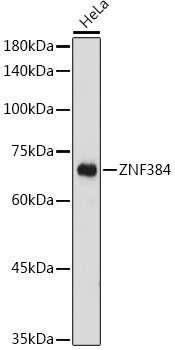
Western blot analysis of lysates from HeLa cells, using ZNF384 Rabbit pAb (CAB15964) at 1:1000 dilution. Secondary antibody: HRP-conjugated Goat anti-Rabbit IgG (H+L) (CABS014) at 1:10000 dilution. Lysates/proteins: 25μg per lane. Blocking buffer: 3% nonfat dry milk in TBST. Detection: ECL Basic Kit (AbGn00020). Exposure time: 10s.
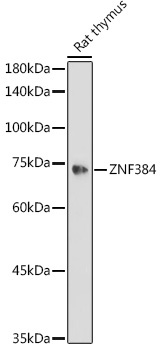
Western blot analysis of lysates from Rat thymus, using ZNF384 Rabbit pAb (CAB15964) at 1:1000 dilution. Secondary antibody: HRP-conjugated Goat anti-Rabbit IgG (H+L) (CABS014) at 1:10000 dilution. Lysates/proteins: 25μg per lane. Blocking buffer: 3% nonfat dry milk in TBST. Detection: ECL Basic Kit (AbGn00020). Exposure time: 90s.
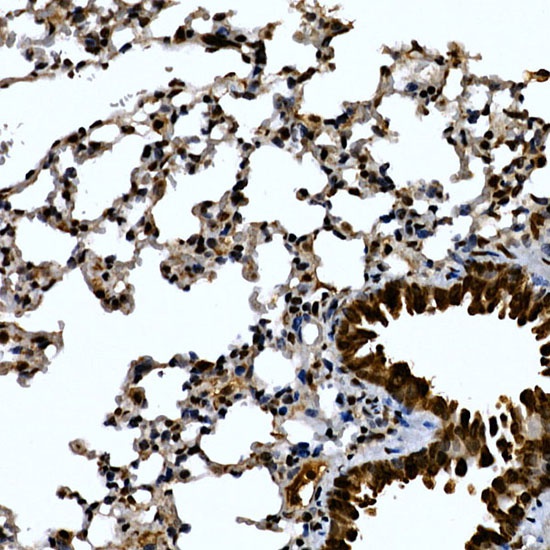
Immunohistochemistry analysis of paraffin-embedded Mouse lung using ZNF384 Rabbit pAb (CAB15964) at dilution of 1:100 (40x lens). High pressure antigen retrieval performed with 0.01M Citrate buffer (pH 6.0) prior to IHC staining.
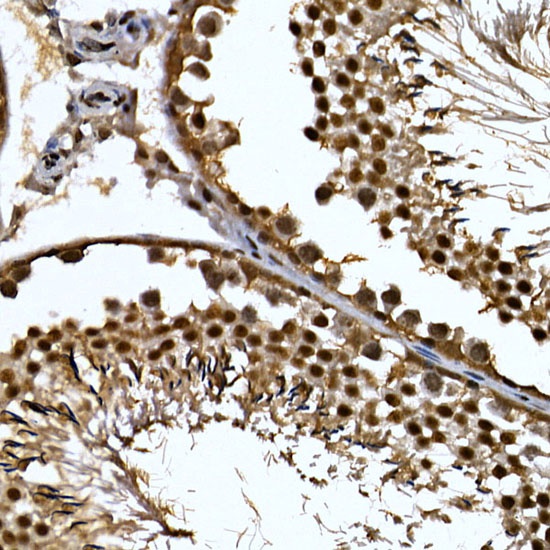
Immunohistochemistry analysis of paraffin-embedded Rat testis using ZNF384 Rabbit pAb (CAB15964) at dilution of 1:100 (40x lens). High pressure antigen retrieval performed with 0.01M Citrate buffer (pH 6.0) prior to IHC staining.