Description
UGT1A1 Monoclonal Antibody (CAB22609)
The UGT1A1 Monoclonal Antibody (CAB22609) is a high-quality antibody developed for reliable detection and analysis of target proteins. This monoclonal antibody has been specifically designed for use in various research applications, including Western blot and immunohistochemistry.Developed using state-of-the-art technology, this antibody offers high specificity and sensitivity for detecting UGT1A1 protein in human samples. Its ability to bind specifically to UGT1A1 makes it an invaluable asset for researchers studying drug metabolism, pharmacokinetics, and personalized medicine.
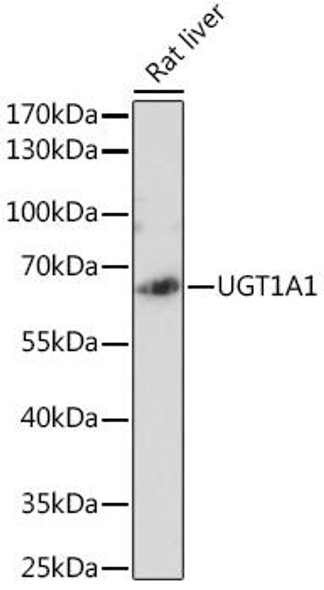
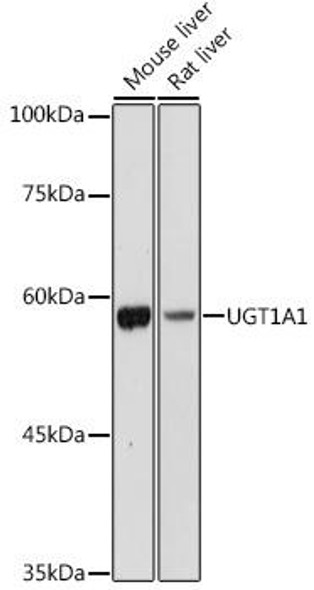
This antibody is validated for use in WB, ELISA applications and has demonstrated reactivity against Human, Rat samples.
| Product Name: | UGT1A1 Monoclonal Antibody |
| SKU: | CAB22609 |
| Size: | 20μL, 100μL |
| Reactivity: | Human, Rat |
| Clone Number: | ARC57754 |
| Conjugate: | Unconjugated |
| Immunogen: | Synthetic peptide. This information is considered to be commercially sensitive. | ||||
| Sequence: | ENDS FLQR VIKT YKKI KKDS AMLL SGCS HLLH NKEL MASL AESS FDVM LTDP FLPC SPIV AQYL SLPT VFFL HALP CSLE FEAT QCPN PFSY VPRP LSSH | ||||
| Tested Applications: | WB ELISA | ||||
| Recommended Dilution: |
| ||||
| Synonyms: | GNT1, UGT1, UDPGT, UGT1A, HUG-BR1, BILIQTL1, UDPGT 1-1, UGT1A1 |
| Positive Sample: | Hep G2, Rat liver |
| Cellular Localization: | Endoplasmic Reticulum, Endoplasmic Reticulum Membrane, Microsome, Single-Pass Membrane Protein. |
| Calculated MW: | 60kDa |
| Observed MW: | 58kDa |
This gene encodes a UDP-glucuronosyltransferase, an enzyme of the glucuronidation pathway that transforms small lipophilic molecules, such as steroids, bilirubin, hormones, and drugs, into water-soluble, excretable metabolites. This gene is part of a complex locus that encodes several UDP-glucuronosyltransferases. The locus includes thirteen unique alternate first exons followed by four common exons. Four of the alternate first exons are considered pseudogenes. Each of the remaining nine 5' exons may be spliced to the four common exons, resulting in nine proteins with different N-termini and identical C-termini. Each first exon encodes the substrate binding site, and is regulated by its own promoter. The preferred substrate of this enzyme is bilirubin, although it also has moderate activity with simple phenols, flavones, and C18 steroids. Mutations in this gene result in Crigler-Najjar syndromes types I and II and in Gilbert syndrome.
| Purification Method | Affinity purification |
| Gene ID | 54658 |
| Buffer Information | Store at -20℃. Avoid freeze / thaw cycles. Buffer: PBS containing 50% glycerol and 0.05% BSA, preserved with proclin300 or sodium azide, pH 7.3. |
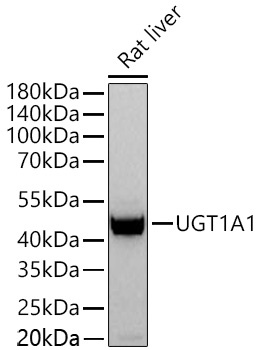 | Western blot analysis of lysates from Rat liver using UGT1A1 Rabbit mAb (CAB22609) at 1:2000 dilution incubated at room temperature for 1.5 hours. Secondary antibody: HRP-conjugated Goat anti-Rabbit IgG (H+L) (CABS014) at 1:10000 dilution. Lysates/proteins: 25 μg per lane. Blocking buffer: 3% nonfat dry milk in TBST. Detection: ECL Basic Kit (AbGn00020). Exposure time: 90 s. |
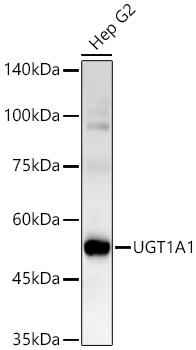 | Western blot analysis of lysates from Hep G2 cells using UGT1A1 Rabbit mAb (CAB22609) at 1:8000 dilution incubated overnight at 4℃. Secondary antibody: HRP-conjugated Goat anti-Rabbit IgG (H+L) (CABS014) at 1:10000 dilution. Lysates/proteins: 25 μg per lane. Blocking buffer: 3% nonfat dry milk in TBST. Detection: ECL Basic Kit (AbGn00020). Exposure time: 60 s. |