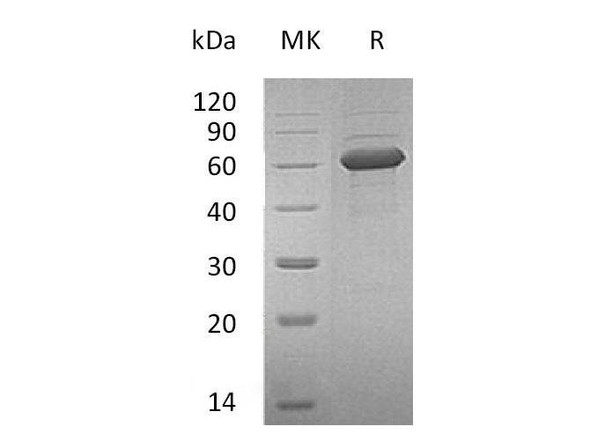
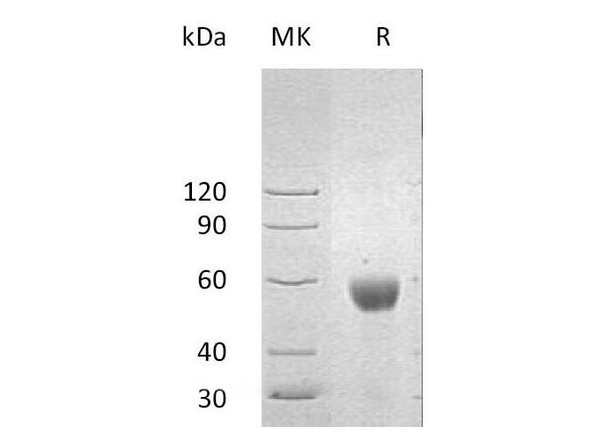
ULBP1; also known as RAET1I and NKG2DL1; is a member of the ULBP/RAET1 gene family. ULBP1 plays an important role in immune responses; especially in cancer and infectious diseases; and is well-known to bind to NKG2D together with at least ULBP 2 and 3. These proteins are distantly related to major histocompatibility class I (MHC I) molecules; possessing the alpha 1 and alpha 2 Ig-like domains; but lacking the alpha 3 domain. Unlike MHC Class I; they have no capacity to bind peptide or interact with beta2-microglobulin. It can activate multiple signaling pathways in primary NK cells; gamma delta T cells; and CD8+ alpha beta T cells; resulting in the production of cytokines and chemokines.ULBP1 is expressed in wide range of tissues including heart; brain; lung; liver; bone marrow and some tumor cells; T-cells; B-cells; As an unconventional member of the MHC class I family; ULBP1 is able to interact with soluble CMV glycoprotein UL16 in CMV infected cells. The interaction with UL16 blocked the interaction with the NKG2D receptor; and thus might escape the immune surveillance. Furthermore; UL16 also causes ULBP1 to be retained in the ER and cis-Golgi apparatus so that it does not reach the cell surface. The ULBP1 regulation may have implications for development of new therapeutic strategies against cancer cells.
Product Name:
Human NKG2DL/ULBP Recombinant Protein (RPES0568)
Product Code:
RPES0568
Size:
10µg
Species:
Human
Expressed Host:
Human Cells
Synonyms:
NKG2D ligand 1, N2DL-1, NKG2DL1, ALCAN-beta, Retinoic acid early transcript 1I, UL16-binding protein 1, ULBP1
Accession:
Q9BZM6
Sequence:
Gly26-Pro215
Fusion tag:
C-6His
Endotoxin:
<1.0 EU per µg as determined by the LAL method.
Protein Construction:
Recombinant Human UL16 Binding Protein-1/NKG2D ligand 1 is produced by our Mammalian expression system and the target gene encoding Gly26-Pro215 is expressed with a 6His tag at the C-terminus.
Purity:
> 95 % as determined by reducing SDS-PAGE.
Mol Mass:
23.3 kDa
AP Mol Mass:
25-30 kDa
Formulation:
Lyophilized from a 0.2 µm filtered solution of PBS; pH 7.4.
Shipping:
This product is provided as lyophilized powder which is shipped with ice packs.
Stability and Storage:
Lyophilized proteins are stable for up to 12 months when stored at -20 to -80°C. Reconstituted protein solution can be stored at 4-8°C for 2-7 days. Aliquots of reconstituted samples are stable at < -20°C for 3 months.