The [KD Validated] Pin1 Monoclonal Antibody (CAB22470) is a high-quality antibody developed for reliable detection and analysis of target proteins. This monoclonal antibody, rigorously validated for specificity and sensitivity, is ideal for a variety of experimental techniques, including Western blotting, immunohistochemistry, and immunoprecipitation.PIN1 is a pivotal enzyme involved in the phosphorylation-dependent prolyl isomerization of key proteins, playing a crucial role in cell cycle regulation, gene transcription, and apoptosis. Dysregulation of PIN1 has been implicated in various diseases, including cancer, neurological disorders, and inflammatory conditions.
This antibody is validated for use in WB, ELISA applications and has demonstrated reactivity against Human, Mouse, Rat samples.
Product Name:
[KD Validated] Pin1 Monoclonal Antibody
SKU:
CAB22470
Size:
20μL, 100μL
Reactivity:
Human, Mouse, Rat
Clone Number:
ARC57311
Conjugate:
Unconjugated
Immunogen:
Recombinant protein (or fragment).This information is considered to be commercially sensitive.
Recommended starting concentration is 1 μg/mL. Please optimize the concentration based on your specific assay requirements.
Synonyms:
DOD, UBL5, [KD Validated] Pin1
Positive Sample:
HeLa, 293T, NIH/3T3, Mouse brain, PC-12, Rat brain
Cellular Localization:
Cytoplasm, Nucleus, Nucleus Speckle.
Calculated MW:
18kDa
Observed MW:
18kDa
Peptidyl-prolyl cis/trans isomerases (PPIases) catalyze the cis/trans isomerization of peptidyl-prolyl peptide bonds. This gene encodes one of the PPIases, which specifically binds to phosphorylated ser/thr-pro motifs to catalytically regulate the post-phosphorylation conformation of its substrates. The conformational regulation catalyzed by this PPIase has a profound impact on key proteins involved in the regulation of cell growth, genotoxic and other stress responses, the immune response, induction and maintenance of pluripotency, germ cell development, neuronal differentiation, and survival. This enzyme also plays a key role in the pathogenesis of Alzheimer's disease and many cancers. Multiple alternatively spliced transcript variants have been found for this gene.
Purification Method
Affinity purification
Gene ID
5300
Buffer Information
Store at -20℃. Avoid freeze / thaw cycles. Buffer: PBS with 0.09% Sodium azide,0.05% BSA,50% glycerol,pH7.3.
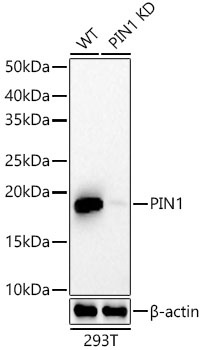
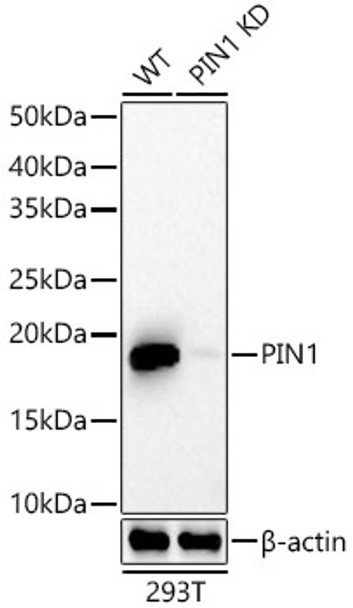
Western blot analysis of lysates from wild type(WT) and Pin1 knockdown (KD) 293T cells, using [KD Validated] Pin1 Rabbit mAb (CAB22470) at 1:2000 dilution. Secondary antibody: HRP-conjugated Goat anti-Rabbit IgG (H+L) (CABS014) at 1:10000 dilution. Lysates/proteins: 25μg per lane. Blocking buffer: 3% nonfat dry milk in TBST. Detection: ECL Basic Kit (AbGn00020). Exposure time: 60s.
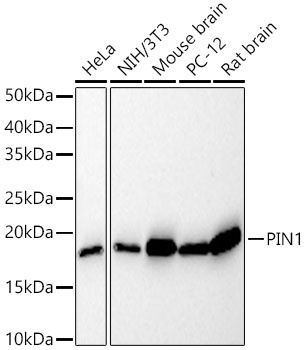
Western blot analysis of various lysates, using [KD Validated] Pin1 Rabbit mAb (CAB22470) at 1:2000 dilution. Secondary antibody: HRP-conjugated Goat anti-Rabbit IgG (H+L) (CABS014) at 1:10000 dilution. Lysates/proteins: 25μg per lane. Blocking buffer: 3% nonfat dry milk in TBST. Detection: ECL Basic Kit (AbGn00020). Exposure time: 60s.