Recombinant Human BAFFR/ TNFRSF13C Protein (hFC Tag) (RPES6037)
Tumor necrosis factor receptor superfamily, member 13C (TNFRSF13C) also known as B-cell-activating factor receptor (BAFFR) and CD268 antigen, is a member of the tumor necrosis factor receptor superfamily. BAFF promotes the survival of B cells and is essential for B cell maturation. BAFF binds to three TNF receptor superfamily members: B-cell maturation antigen (BCMA/TNFRSF17), transmembrane activator and calcium-modulator and cyclophilin ligand interactor (TACI/TNFRSF13B) and BAFF receptor (BAFF R/BR3/TNFRSF13C). These receptors are type III transmembrane proteins that lack a signal peptide. BAFF R is highly expressed in spleen, lymph node and resting B cells. It is also expressed at lower levels in activated B cell, in resting CD4+ T cells, in thymus and peripheral blood leukocytes. BAFF knockout mice lack mature B cells. Similarly, A/WySnJ mice that are defective in BAFF-R intracellular signaling also lack mature B cells, suggesting that BAFF R is the critical receptor for BAFF during B lymphopoiesis. It has been proposed that abnormally high levels of BAFFR/TNFRSF13C (CD268) may contribute to the pathogenesis of autoimmune diseases by enhancing the survival of autoreactive B cells.
Product Name:
Recombinant Human BAFFR/ TNFRSF13C Protein (hFC Tag)
SKU:
RPES6037
Size:
100μg, 20μg, 500μg, 1mg
Species:
Human
Synonyms:
BAFF R, BAFFR, BR3, CD268, TNFRSF13C
Tag:
C-hFC
Sequence:
Ser7-Ala71
Expression Host:
HEK293 Cells
Accession:
Q96RJ3
Endotoxin:
< 1.0 EU/mg of the protein as determined by the LAL method
Purity:
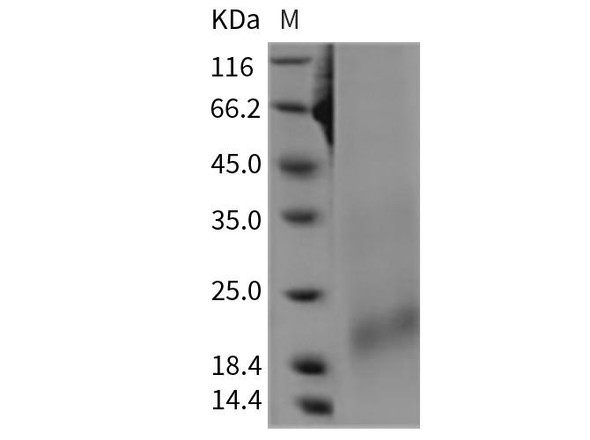
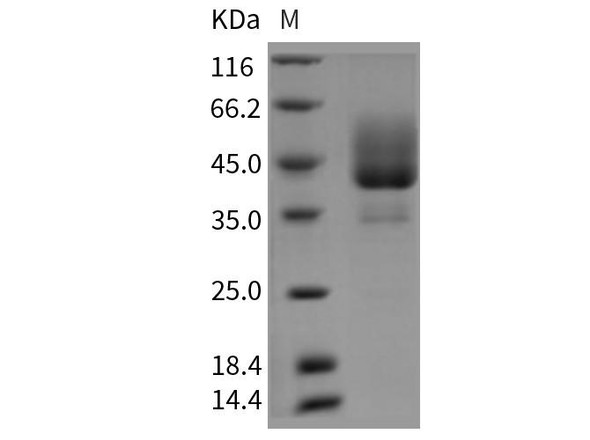
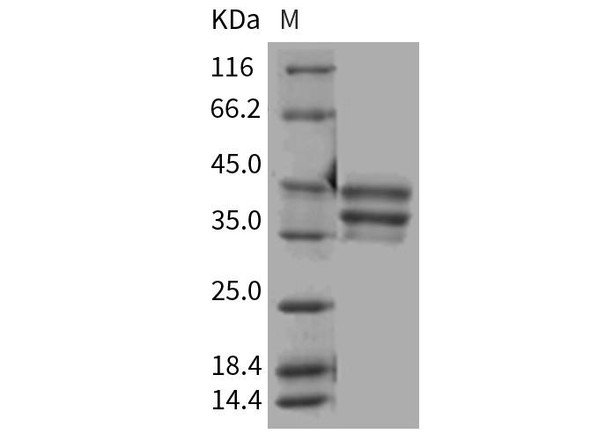
> 85% as determined by reducing SDS-PAGE.
Calculated MW:
42.0 kDa
Observed MW:
42 kDa
Bio-Activity:
Not validated for activity
Form:
Lyophilized powder
Source:
HEK293 Cells-derived Human BAFFR, TNFRSF13C protein Ser7-Ala71, with an C- terminal hFC
Formulation:
Lyophilized from a 0.2 μm filtered solution in PBS with 5% Trehalose and 5% Mannitol.
Reconstitution:
It is recommended that sterile water be added to the vial to prepare a stock solution of 0.5 mg/mL. Concentration is measured by UV-Vis.
Storage:
Generally, lyophilized proteins are stable for up to 12 months when stored at -20 to - 80℃. Reconstituted protein solution can be stored at 4-8℃ for 2-7 days. Aliquots of reconstituted samples are stable at < -20℃ for 3 months.
Shipping:
This product is provided as lyophilized powder which is shipped with ice packs.