The Cyclin A1/A2 Monoclonal Antibody (CAB2635) is a high-quality antibody developed for reliable detection and analysis of target proteins. Cyclin A1 and A2 are key regulators of cell cycle progression, playing essential roles in cell division and proliferation. This antibody, produced for research purposes, is optimized for detecting cyclin A1 and A2 in human samples, making it ideal for investigating the role of these proteins in various biological processes.Cyclin A1 and A2 are known to be dysregulated in various diseases, including cancer, making them attractive targets for therapeutic interventions.
This antibody is validated for use in WB, IP, ELISA applications and has demonstrated reactivity against Human, Mouse samples.
Product Name:
Cyclin A1/A2 Monoclonal Antibody
SKU:
CAB2635
Size:
20μL, 100μL
Reactivity:
Human, Mouse
Clone Number:
ARC2642
Conjugate:
Unconjugated
Immunogen:
Recombinant protein (or fragment).This information is considered to be commercially sensitive.
0.5μg-4μg antibody for 400μg-600μg extracts of whole cells
ELISA
Recommended starting concentration is 1 μg/mL. Please optimize the concentration based on your specific assay requirements.
Synonyms:
CCN1, CCNA, CT146, Cyclin A1/A2
Positive Sample:
U-937, K-562, Mouse thymus
Cellular Localization:
Cytoplasm, Nucleus.
Calculated MW:
49kDa/52kDa
Observed MW:
52kDa(CyclinA1)/49kDa(CyclinA2)
The protein encoded by this gene belongs to the highly conserved cyclin family, whose members function as regulators of the cell cycle. This protein binds and activates cyclin-dependent kinase 2 and thus promotes transition through G1/S and G2/M.The protein encoded by this gene belongs to the highly conserved cyclin family, whose members are characterized by a dramatic periodicity in protein abundance through the cell cycle. Cyclins function as regulators of CDK kinases. Different cyclins exhibit distinct expression and degradation patterns which contribute to the temporal coordination of each mitotic event. The cyclin encoded by this gene was shown to be expressed in testis and brain, as well as in several leukemic cell lines, and is thought to primarily function in the control of the germline meiotic cell cycle. This cyclin binds both CDK2 and CDC2 kinases, which give two distinct kinase activities, one appearing in S phase, the other in G2, and thus regulate separate functions in cell cycle. This cyclin was found to bind to important cell cycle regulators, such as Rb family proteins, transcription factor E2F-1, and the p21 family proteins. Multiple transcript variants encoding different isoforms have been found for this gene.
Purification Method
Affinity purification
Gene ID
890 8900
Buffer Information
Store at -20℃. Avoid freeze / thaw cycles. Buffer: PBS containing 50% glycerol and 0.05% BSA, preserved with proclin300 or sodium azide, pH 7.3.
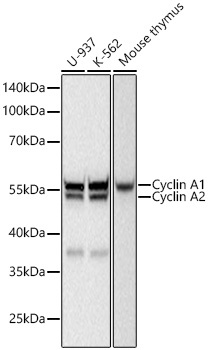
Western blot analysis of various lysates using Cyclin A1/A2 Rabbit mAb (CAB2635) at 1:5000 dilution incubated at room temperature for 1.5 hours. Secondary antibody: HRP-conjugated Goat anti-Rabbit IgG (H+L) (CABS014) at 1:10000 dilution. Lysates/proteins: 25 μg per lane. Blocking buffer: 3% nonfat dry milk in TBST. Detection: ECL Basic Kit (AbGn00020). Exposure time: 90 s.
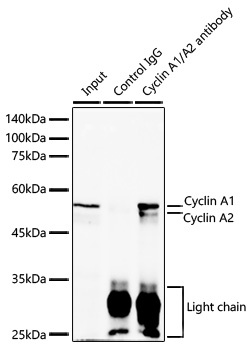
Immunoprecipitation analysis of 600 μg extracts of Mouse thymus using 3 μg Cyclin A1/A2 Rabbit mAb (CAB2635). Western blot was performed from the immunoprecipitate using Cyclin A1/A2 Rabbit mAb (CAB2635) at a dilution of 1:1000.



![Anti-Cyclin A1/A2 [R07-3D4] Monoclonal Antibody (AGMB02579)](https://cdn11.bigcommerce.com/s-h68l9z2lnx/images/stencil/590x590/products/273868/680514/anti-cyclin-a1a2-r07-3d4-monoclonal-antibody-agmb02579__32856.1773042278.jpg?c=2 "Anti-Cyclin A1/A2 [R07-3D4] Monoclonal Antibody (AGMB02579)")